
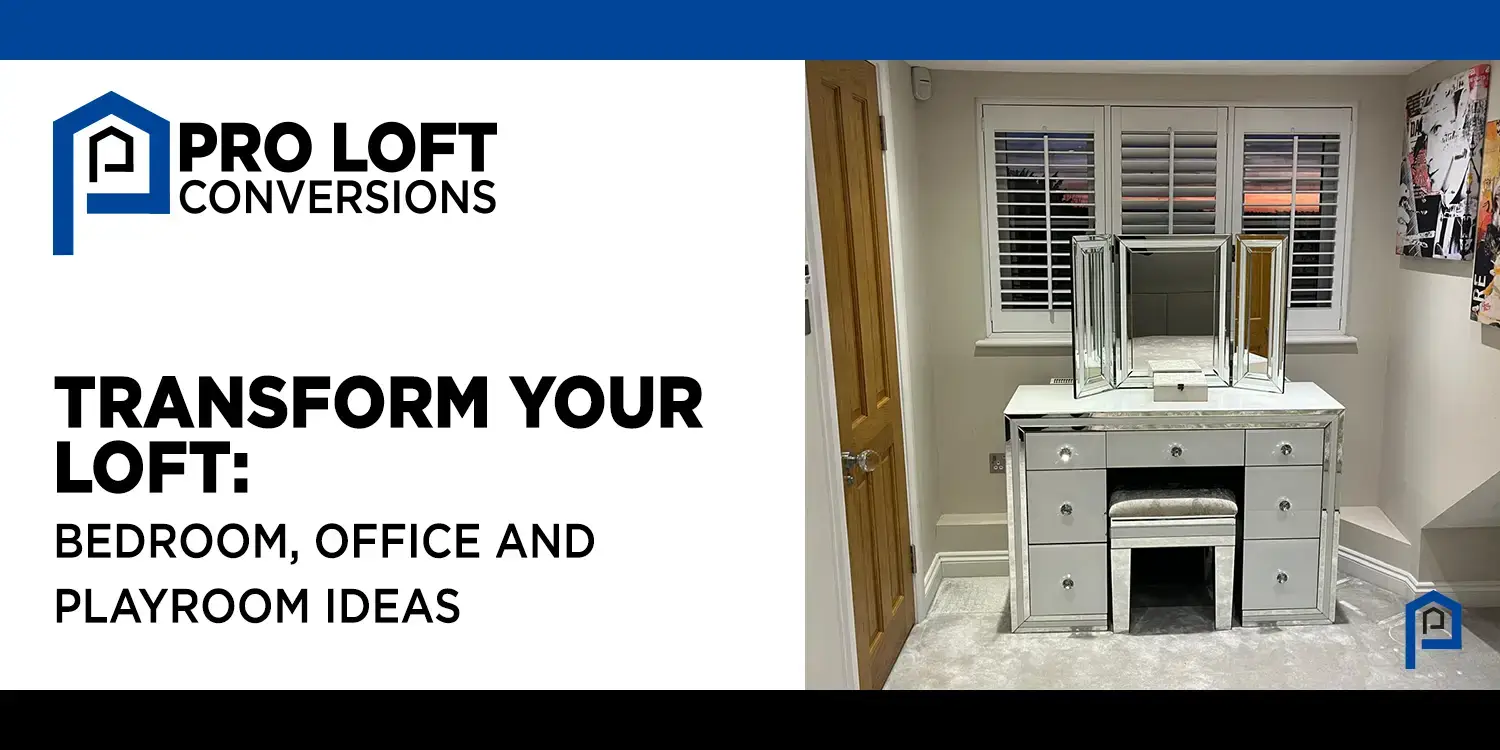
Transform Your Loft: Bedroom, Office & Playroom Ideas
If you are looking at your roof space and wondering how to make it work harder, you are not alone. A well planned loft can
If you are looking for extra space without moving, a loft conversion can be a smart, value-adding way to change how you live. The roof is often the biggest unused area in a home, so turning it into a bright bedroom, apeaceful study, or a play space can make daily life easier. Still, not every loft is ready for conversion, and not every household needs the same solution. This guide walks you through the key questions to ask, from size and head height to stairs, storage, planning, and budget. You will also see how we at Pro Loft Conversions support you through feasibility, design, and build so you can decide with confidence.
Three things matter most when judging whether your loft is suitable: head height, footprint, and roof structure.
Head height: As a rule of thumb, you want at least 2.2 metres of clear height at the loft’s highest point before any works. This usually allows enough space for floor build-up and insulation while still delivering comfortable standing height in the finished room. If your loft is slightly under this, solutions exist, such as adjusting ceiling levels below, but this needs careful assessment.
Footprint: A simple way to think about usable area is to focus on the central zone where you can stand up straight. That is where you will place a bed, desk, or wardrobe. Sloping sides can still be valuable for storage with built-in units. Most homes with a roof span of at least 5.5 to 6.5 metres and a reasonable depth can achieve a practical layout.
Roof type: Traditional rafter roofs are usually straight forward. Trussed roofs, common in later homes, can also be converted but require additional structural work and design. This is where an initial survey pays off, since a structural plan will confirm feasibility and options.
During our first visit, we measure your head height and footprint, check the structure, and outline what type of conversion would best unlock space, such as a Velux only approach, a dormer, hip to gable, or a mansard.
For many households, yes. Here is why:
Of course, it is not the right choice for every home. If your ground floor layout is cramped, a kitchen extension might solve more problems. The best approach is to define the outcome you want first, then assess whether the loft can deliver that outcome comfortably.
Before you dive in, take stock of the practical points below. They will shape budget, permissions, and design.
Different homes suit different approaches. Here are the most common options we design and build:
We will talk you through what fits your roof, budget, and planning context, then show example layouts so you can picture furniture and circulation clearly.
Our three phase process keeps things simple and predictable.
We are friendly, responsive, and focused on making the experience straightforward for you.
We will always tell you if the numbers or constraints do not stack up. Typical red flags include very low head height with no sensible remedy, heavily protected planning settings that limit changes, or a downstairs layout that will not accept a staircase without major compromise. In those cases, we can advise on alternative routes, from reconfiguring existing rooms to considering a ground floor extension.
If you are still weighing it up, start with a site visit. You will learn exactly how much usable space you can gain, stair options, and whether you need planning. If you are ready to explore specific designs like a dormer loft conversion, we can share examples and costs so you can compare approaches. For a quick guide to schedules, see how long does a loft conversion take.
A loft conversion can be a brilliant way to add a bedroom, create a calm study, or carve out a flexible family space, often with less disruption than extending out. Check your head height, think through stairs and storage, consider light and ventilation, and be clear on how you will use the room. With solid planning and a trusted team, you can transform unused roof space into a space you love. If you would like expert, local advice and a smooth, end to end service, we are here to help.
Start by completing a few simple questions to give you an idea of the cost involved. Click the button below!
Recent studies show that a loft conversion that added a double bedroom and bathroom to a three-bed, one-bathroom house can add over 20 per cent to its value.
If you are looking at your roof space and wondering how to make it work harder, you are not alone. A well planned loft can
Thinking about a loft conversion but worried it will turn your home upside down? You’re not alone. The good news is that with careful planning,
If you are looking for extra space without moving, a loft conversion can be a smart, value-adding way to change how you live. The roof
Start planning your new loft space with an idea of the cost involved. Get an instant quote today. All quotes are of course subject to a site survey.
Start planning with an idea of the cost involved. Get an instant quote today! All quotes are subject to a site survey.
This website uses cookies to ensure you get the best experience on our website, by continuing we’ll assume you are okay with this. For more information please visit our Privacy Policy page.